

What Percentage Of America Is Registered Republican
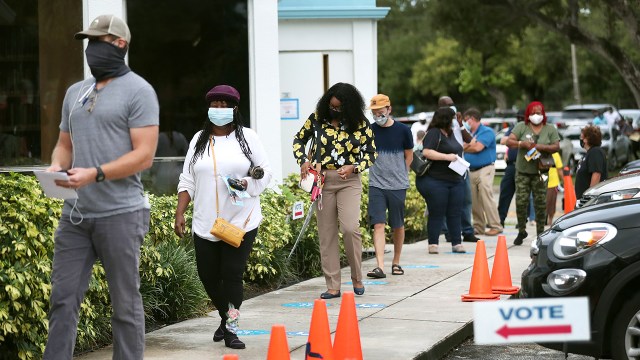
The Us holds a presidential ballot every four years, but it's not but the candidates and issues that modify from one campaign wheel to the next. The electorate itself is in a tiresome just abiding state of flux, besides.
The profile of the U.Due south. electorate can change for a diverseness of reasons. Consider the millions of Americans who have turned 18 and can vote for president for the first time this year, the immigrants who have become naturalized citizens and tin can cast ballots of their ain, or the longer-term shifts in the country'south racial and ethnic makeup. These and other factors ensure that no two presidential electorates look exactly the same.
So what does the 2020 electorate look like politically, demographically and religiously as the race between Republican President Donald Trump and Democrat Joe Biden enters its concluding days? To respond that question, here's a roundup of recent Pew Enquiry Center findings. Unless otherwise noted, all findings are based on registered voters.
Party identification
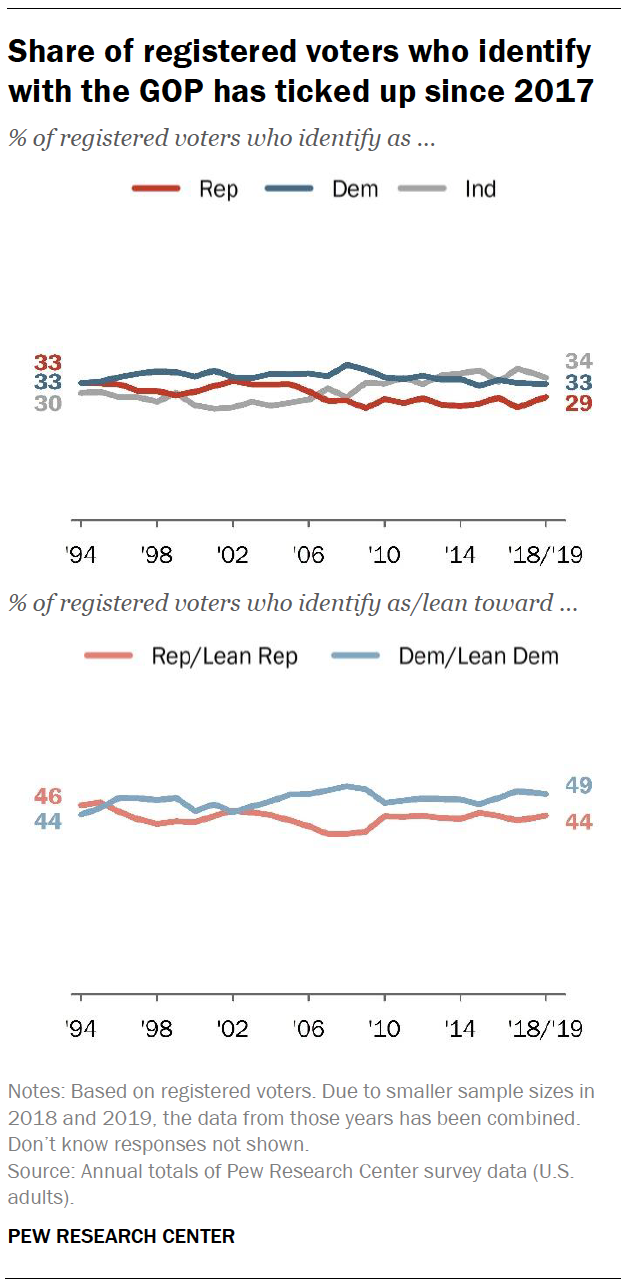
Around a third of registered voters in the U.S. (34%) identify as independents, while 33% identify as Democrats and 29% place equally Republicans, according to a Middle analysis of Americans' partisan identification based on surveys of more than 12,000 registered voters in 2018 and 2019.
Most independents in the U.Due south. lean toward one of the two major parties. When taking independents' partisan leanings into account, 49% of all registered voters either place as Democrats or lean to the party, while 44% identify as Republicans or lean to the GOP.
Party identification among registered voters hasn't changed dramatically over the by 25 years, but there have been some modest shifts. One such shift is that the Autonomous Party's advantage over the Republican Party in party identification has get smaller since 2017. Of course, just because a registered voter identifies with or leans toward a detail party does non necessarily mean they will vote for a candidate of that party (or vote at all). In a study of validated voters in 2016, 5% of Democrats and Autonomous leaners reported voting for Trump, and four% of Republicans and GOP leaners reported voting for Hillary Clinton.
Race and ethnicity
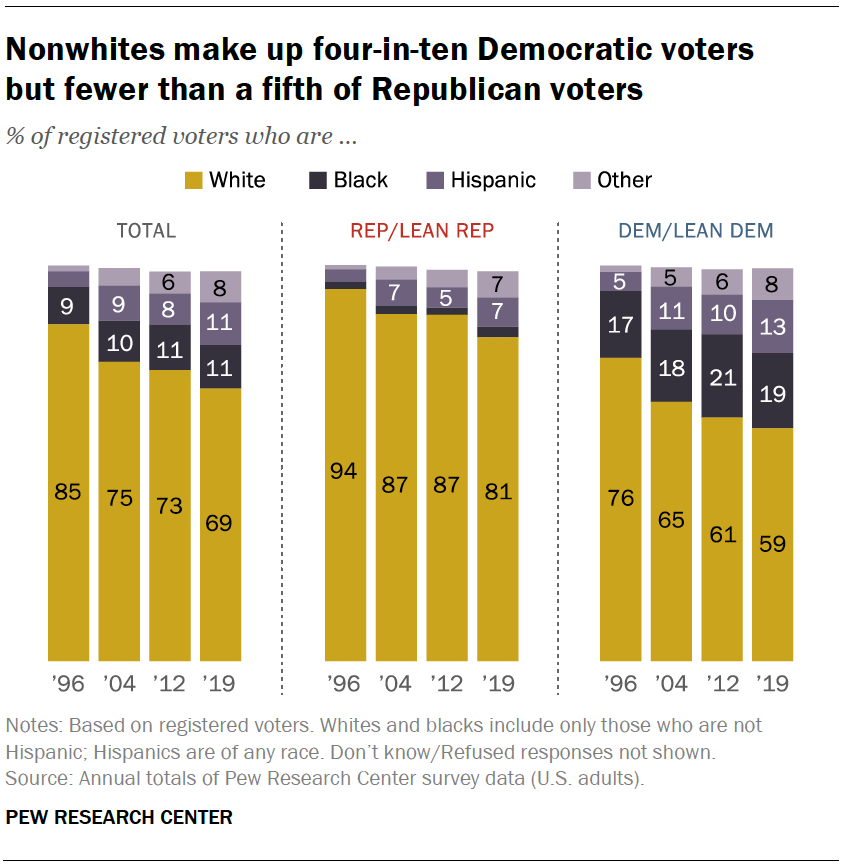
Non-Hispanic White Americans make up the largest share of registered voters in the U.Southward., at 69% of the total every bit of 2019. Hispanic and Black registered voters each account for xi% of the total, while those from other racial or ethnic backgrounds account for the balance (eight%).
White voters account for a diminished share of registered voters than in the past, failing from 85% in 1996 to 69% ahead of this year'south election. This change has unfolded in both parties, simply White voters accept consistently accounted for a much larger share of Republican and Republican-leaning registered voters than of Democratic and Democratic-leaning voters (81% vs. 59% as of 2019).
The racial and ethnic composition of the electorate looks very different nationally than in several cardinal battleground states, according to a Centre analysis of 2018 data based on eligible voters – that is, U.S. citizens ages 18 and older, regardless of whether or not they were registered to vote.
White Americans accounted for 67% of eligible voters nationally in 2018, only they represented a much larger share in several key battlegrounds in the Midwest and Mid-Atlantic, including Wisconsin (86%), Ohio (82%), Pennsylvania (81%) and Michigan (79%). The reverse was true in some battlefield states in the Westward and South. For instance, the White share of eligible voters was below the national average in Nevada (58%), Florida (61%) and Arizona (63%). You can come across racial and ethnic breakdown of eligible voters in all fifty states – and how it changed betwixt 2000 and 2018 – with this interactive feature.
Historic period and generation
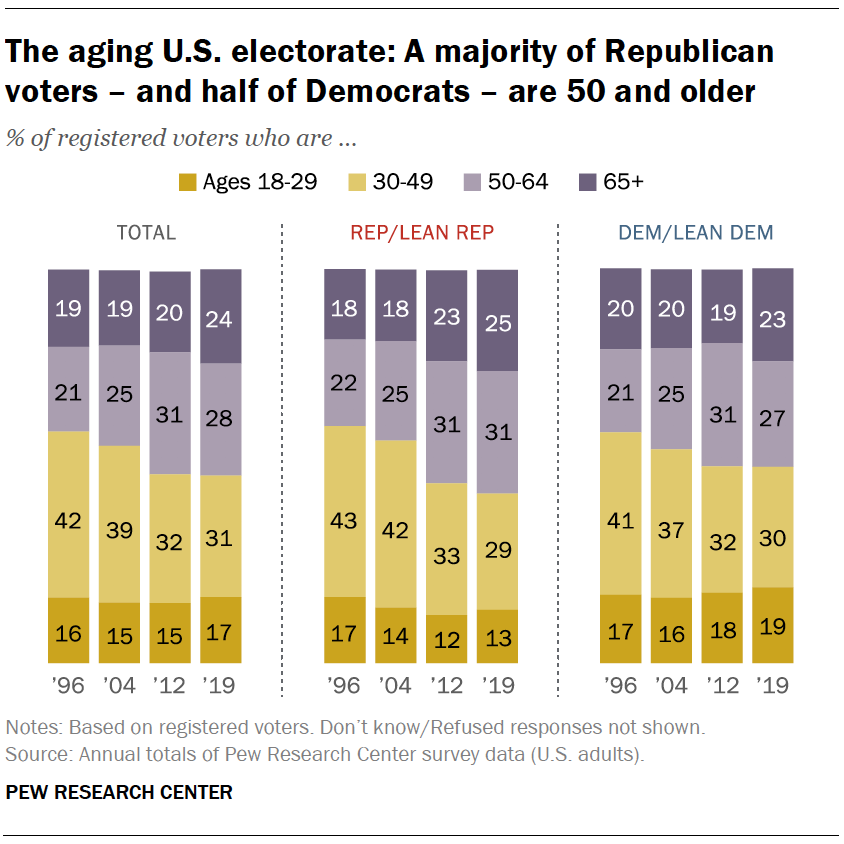
The U.S. electorate is aging: 52% of registered voters are ages l and older, upwardly from 41% in 1996. This shift has occurred in both partisan coalitions. More than half of Republican and GOP-leaning voters (56%) are ages 50 and older, upward from 39% in 1996. And among Democratic and Democratic-leaning voters, half are 50 and older, up from 41% in 1996.
Another way to consider the aging of the electorate is to look at median age. The median age amongst all registered voters increased from 44 in 1996 to 50 in 2019. Information technology rose from 43 to 52 among Republican registered voters and from 45 to 49 among Democratic registered voters.
Despite the long-term aging of registered voters, 2020 marks the first time that many members of Generation Z – Americans born after 1996 – will be able to participate in a presidential election. Ane-in-10 eligible voters this year are members of Generation Z, up from just iv% in 2016, co-ordinate to Pew Enquiry Eye projections. (Of course, not all eligible voters end up registering and actually casting a election.)
Education
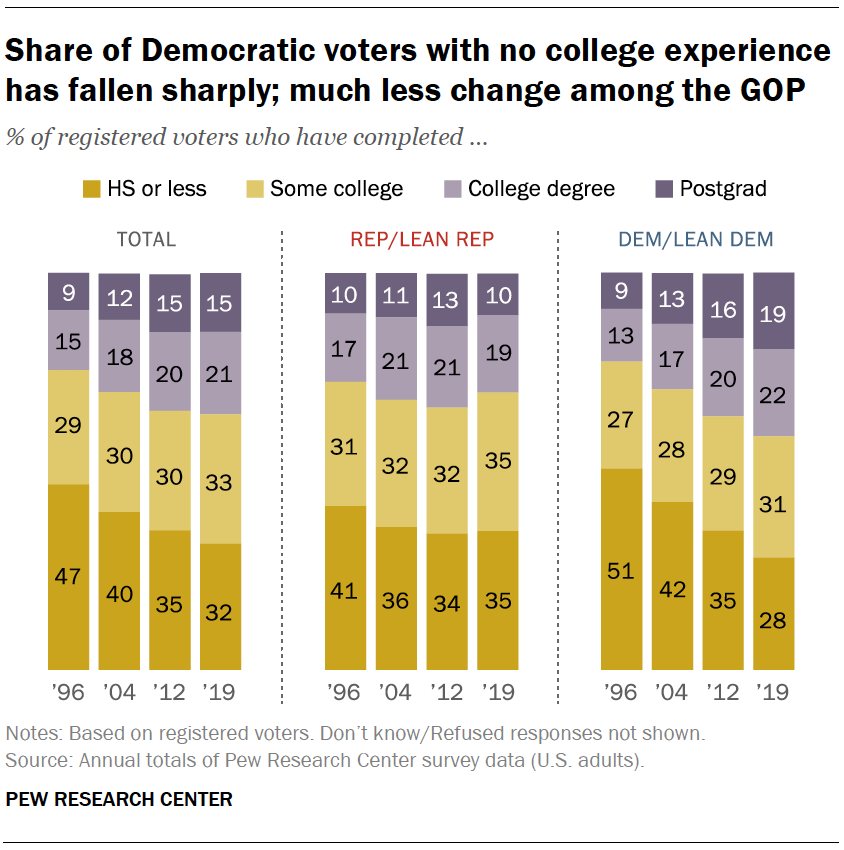
Effectually two-thirds of registered voters in the U.S. (65%) do non have a college degree, while 36% do. But the share of voters with a higher degree has risen essentially since 1996, when 24% had 1.
Voters who identify with the Autonomous Party or lean toward information technology are much more likely than their Republican counterparts to accept a higher degree (41% vs. thirty%). In 1996, the contrary was true: 27% of GOP voters had a college degree, compared with 22% of Autonomous voters.
Religion
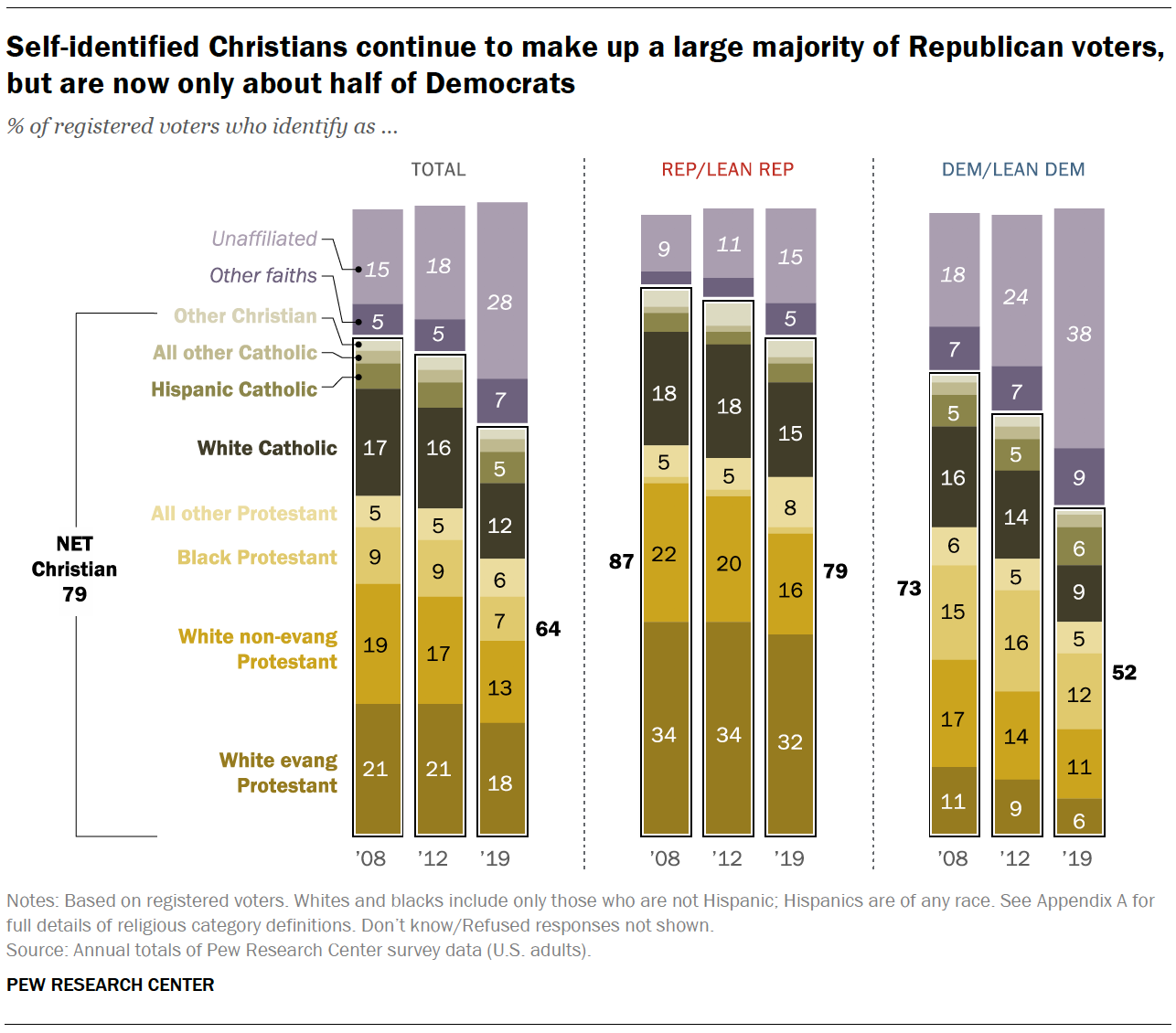
Christians account for the bulk of registered voters in the U.S. (64%). Only this figure is downward from 79% as recently as 2008. The share of voters who place as religiously unaffiliated has nearly doubled during that span, from fifteen% to 28%.
The share of White Christians in the electorate, in detail, has decreased in contempo years. White evangelical Protestants account for 18% of registered voters today, down from 21% in 2008. During the same period, the share of voters who are White non-evangelical Protestants fell from 19% to 13%, while the share of White Catholics cruel from 17% to 12%.
Effectually eight-in-ten Republican registered voters (79%) are Christians, compared with about half (52%) of Democratic voters. In turn, Democratic voters are much more likely than GOP voters to identify equally religiously unaffiliated (38% vs. 15%).
The primal question: What near voter turnout?
Surveys can provide reliable estimates about registered voters in the U.S. and how their partisan, demographic and religious contour has changed over time. Just the critical question of voter turnout – who will be motivated to cast a election and who will non – is more difficult to answer.
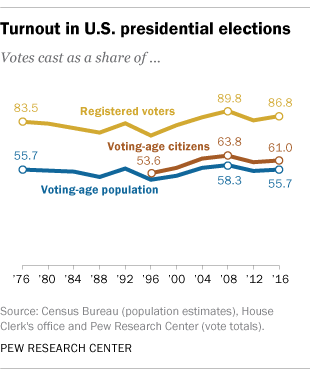
For i thing, non all registered voters finish upwardly voting. In 2016, effectually 87% of registered voters cast a ballot, according to a Pew Research Middle assay of Census Bureau data shortly after that year's election.
Also, voter turnout in the U.S. is non a constant: It can and does change from one ballot to the next. The share of registered voters who cast a ballot was higher in 2008 than four years ago, for example.
Turnout also varies past demographic factors, including race and ethnicity, age and gender. The turnout rate among Black Americans, for instance, exceeded the rate among White Americans for the first time in the 2012 presidential election, merely that pattern did not hold four years later.
So what does all this mean for 2020? There are some early indications that overall turnout could reach a tape high this year, merely every bit turnout in the midterms two years ago reached its highest point in a century. But 2020 is far from an ordinary yr. The combination of a global pandemic and public concerns about the integrity of the election have created widespread doubt, and that uncertainty makes it even more difficult than usual to assess who volition vote and who won't.

What Percentage Of America Is Registered Republican,
Source: https://www.pewresearch.org/fact-tank/2020/10/26/what-the-2020-electorate-looks-like-by-party-race-and-ethnicity-age-education-and-religion/
Posted by: pikeancer1992.blogspot.com
0 Response to "What Percentage Of America Is Registered Republican"
Post a Comment